Turning an Existing Product Idea Into a SaaS Platform: What Businesses Need to Consider
· 8 min · Faiz Khan
Turning a product idea into a SaaS platform involves more than building an application. Businesses need to consider users, subscriptions, architecture, security, scalability, integrations, and how the product will evolve over time.
Faiz Khan
A product idea can start as a simple solution to a specific business problem. Turning that idea into a SaaS platform is a different challenge because the product needs to support users continuously, handle changing requirements, and provide a reliable experience as the number of customers grows.
A SaaS product is not simply an application that happens to run online. It is a product that customers access repeatedly, often through their own accounts, organizations, workflows, and permissions.
That means the business and technical foundations need to be considered together from the beginning.
What Makes a Product a SaaS Platform?
A SaaS platform allows customers to access software through the internet without requiring the product to be installed and maintained individually on their devices.
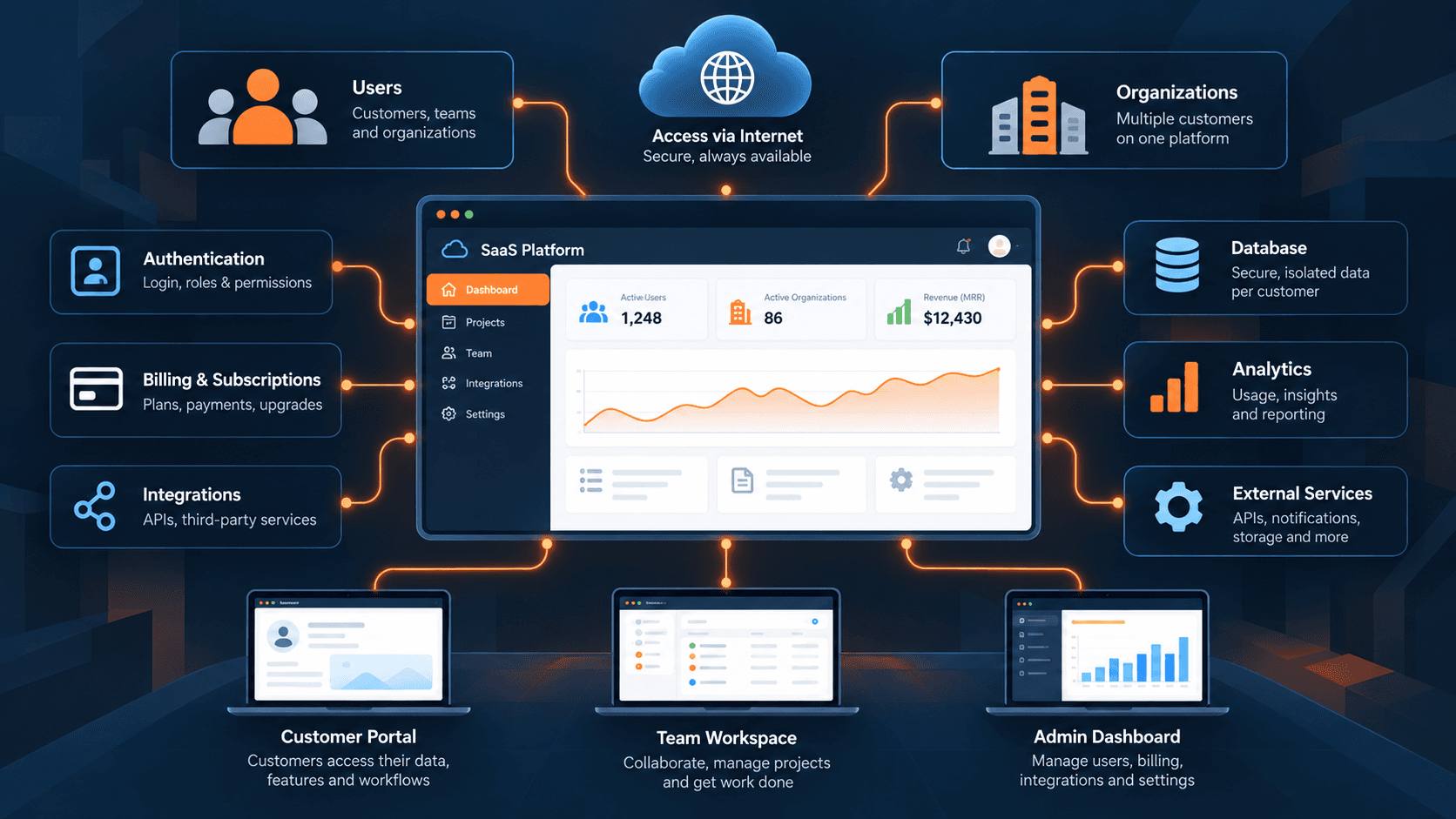
A typical SaaS product may provide:
- Customer accounts
- Secure login and authentication
- Personalized dashboards
- Organization or workspace management
- Core business workflows
- Data management
- Integrations with external services
- Notifications
- Billing or subscription management
- Ongoing product updates
The exact functionality depends on the product, but the important distinction is that customers use the software as an ongoing service.
The platform needs to support not just the first interaction, but the entire relationship between the customer and the product.
Start With the Product, Not the Technology
One of the easiest mistakes when building a SaaS product is starting with technology before clearly defining the product itself.
The first questions should be about the customer, the problem, and the workflow.
Who Is the Product For?
A SaaS platform should have a clear understanding of who will use it.
Different customers may have different needs, levels of access, workflows, and expectations.
Understanding the intended users helps determine everything from the interface to permissions and account structure.
What Problem Does It Solve?
A product should be built around a meaningful problem rather than simply a collection of features.
For example, instead of defining a product as:
- Dashboard
- Reports
- Notifications
- User management
it is more useful to define the underlying problem:
A business needs a centralized way for its teams to manage requests, track progress, and understand operational activity.
That problem provides much stronger direction for the product.
What Does the First Version Need to Do?
The first version should focus on the core workflow that delivers value to customers.
That might mean allowing users to:
- Create an account
- Set up their workspace
- Complete the primary workflow
- View relevant information
- Manage their account
- Receive important updates
The goal is not necessarily to build every feature that might eventually exist.
What Can Wait Until Later?
Some features may be useful but not essential to the initial product.
Advanced reporting, complex integrations, additional roles, automation, and other capabilities can often be introduced as the product evolves.
Defining what belongs in the first version helps control complexity and creates a clearer development path.
Designing the SaaS User Experience
A SaaS product is something customers may use repeatedly, so the experience needs to support more than a single transaction.
Common parts of the experience include:
- Registration
- Login
- Account setup
- Onboarding
- Dashboard
- Core product workflows
- Account settings
- Notifications
- Help and support
The user should understand where they are, what they can do, and what needs attention.
For products with multiple workflows, the interface also needs to make the relationship between different parts of the system clear.
A customer should not have to understand the underlying technology to use the product effectively.
Multi-Tenant SaaS Architecture
Many SaaS platforms are designed so that multiple customers can use the same product while their information and access remain appropriately separated.
This is often described as a multi-tenant architecture.
A platform may contain:
- Organizations
- Users
- Roles
- Permissions
- Customer-specific data
- Shared platform functionality
For example, two businesses may use the same SaaS platform, but each business should only have access to the users, records, projects, and information belonging to its own organization.
The exact architecture depends on the product requirements and security model, but data isolation and access control need to be considered as fundamental parts of the system.
Authentication, Roles, and Permissions
SaaS platforms commonly need to distinguish between different types of users.
For example:
- Owner
- Administrator
- Manager
- Team member
- Customer
Each role may need different permissions.
An administrator might manage users and settings, while a team member may only be able to work with assigned records.
Permissions should be based on actual business workflows rather than being added as an afterthought.
Authentication also needs to support the full customer lifecycle, including account creation, login, password recovery, session management, and appropriate access controls.
Subscription and Billing Considerations
Some SaaS products use recurring subscriptions, while others may use different pricing or commercial models.
Where subscriptions are part of the product, the platform may need to manage:
- Plans
- Pricing
- Monthly or annual billing
- Payment methods
- Upgrades
- Downgrades
- Plan limits
- Billing status
- Failed payments
Billing should be considered as part of the overall product workflow rather than as an isolated payment screen.
For example, changing a customer's plan may affect the features, users, storage, or usage limits available to that account.
The technical implementation will depend on the payment provider and business model.
Integrations and APIs
SaaS products frequently need to communicate with other systems.
These may include:
- Payment providers
- Email services
- Notification platforms
- CRM systems
- Analytics services
- Cloud storage
- Authentication services
- Internal business systems
- Other third-party APIs
APIs provide a structured way for the SaaS platform to exchange information with these services.
The integration architecture should be considered early because external services can influence the product's workflows, data structures, error handling, and user experience.
For example, a SaaS platform that sends notifications or processes payments needs to account for situations where an external service is temporarily unavailable.
Security and Data Protection
SaaS platforms can handle significant amounts of customer and business information, making security an important part of the product architecture.
Depending on the product, considerations may include:
- Authentication
- Authorization
- Role-based access
- Secure API communication
- Secure data handling
- Data isolation
- Backups
- Monitoring
- Error handling
- Infrastructure security
Security should be considered throughout development rather than treated as a final checklist before launch.
The appropriate controls depend on the type of data, users, integrations, infrastructure, and regulatory requirements involved.
Building for Scale Without Overbuilding
A SaaS product should have a foundation that can evolve, but that does not mean every possible future requirement needs to be implemented from the beginning.
There is a balance between building something that can grow and introducing unnecessary complexity too early.
Important areas to consider include:
- Application architecture
- Database design
- API design
- Performance
- Infrastructure
- Monitoring
- Caching where appropriate
- Background processing where required
A smaller SaaS product may not need a highly distributed architecture from day one.
The better approach is to understand the expected product requirements and create a foundation that can evolve as real usage and business needs become clearer.
What Should the First SaaS Version Include?
The first version should focus on the workflows that make the product useful to its intended customers.
Core User Journey
Define the primary action customers need to complete.
This could be creating a project, managing an account, submitting a request, processing an order, or completing another business workflow.
Account Management
Customers may need to register, sign in, manage their profile, and control account settings.
If organizations are involved, the system may also need organization and team management.
Core Product Functionality
The first version should deliver the central capability that customers are paying to use.
Additional features can be added as the product develops.
Essential Integrations
Only integrations that are required for the core workflow need to be part of the initial version.
Other integrations can be introduced later when there is a clear business need.
Administration
The business operating the SaaS product may need tools to manage users, organizations, settings, support requests, and other operational information.
Analytics and Monitoring
Basic analytics and system monitoring can help the team understand how the product is being used and identify technical problems that need attention.
What Happens After Launch?
Launching a SaaS product is the beginning of its lifecycle rather than the end of development.
After launch, the product may require:
- Bug fixes
- Monitoring
- Security updates
- Performance improvements
- New features
- Customer feedback
- Infrastructure changes
- Product iteration
Customer behavior can reveal requirements that were not obvious during initial development.
A SaaS platform therefore needs a development approach that can accommodate continuous improvement.
This is also where ongoing software support and maintenance can become an important part of the product lifecycle.
When Should You Consider Building a SaaS Platform?
A SaaS model may make sense when the same product can provide value to multiple customers over time.
Common signals include:
- The product solves a repeatable problem
- Customers need ongoing access
- Customers need individual accounts
- Multiple users or organizations need controlled access
- The product contains repeatable workflows
- The business expects the product to evolve
- Customers can access the product through the internet
- The business model supports an ongoing software service
These signals do not automatically mean SaaS is the right model. The product, customers, business model, and operational requirements should all be considered together.
Building a SaaS Product Around the Business
A successful SaaS product starts with the business problem and grows from there.
A useful way to think about the process is:
Business Problem → Users → Core Workflow → Architecture → Product → Continuous Improvement
Understanding the business problem helps define what the users need.
Those workflows then shape the product requirements, which inform the architecture and technology.
As the product grows, real customer usage and business requirements can guide future development.
At CodeApricot, we approach SaaS development around that broader context—understanding what the product needs to accomplish, designing the underlying systems around those requirements, and creating a foundation that can evolve with the business.
Our SaaS Development solutions are designed around business requirements rather than a one-size-fits-all technology stack.
Ready to Turn Your Product Idea Into a SaaS Platform?
Turning an idea into a SaaS product requires a clear understanding of the problem, users, workflows, technology, and long-term product requirements.
If you're exploring a SaaS product or planning to turn an existing business process into a scalable software platform, start a project with CodeApricot.
Stay Updated
Receive practical insights, engineering perspectives, and business-focused technology articles delivered as new content becomes available.
Looking For Guidance On Your Next Project?
Whether you're exploring new technology, planning a digital product, or solving a business challenge, we'd be happy to discuss your goals and help you identify the right approach.